Well, I admit it. Before my writing class, I wasn't a blogger. In fact, I'd only ever written one blog post in my life, and it was very . . . dry.
When I wrote my first blog post for this class, I really had no idea what blogging was all about. I assumed my blogging skills would have magically improved from my previous attempt. I compared, and realized my new blog post was . . . also dry. Sahara Desert sand.
As time passed, though, I decided to take the project to heart. I blogged away and started really having fun, and I started finding pictures and video clips to visually enhance what I was trying to say.
That ran me into a new problem—the temptation to let my visuals do the talking for me. For that reason, I cut a few of my visuals and worked to make my text look more visually appealing. Now I've learned how to make visuals and text work together to create visual appeal.
As I look back to my first posts, I realize how my writing has grown and changed. As the semester has progressed, I've incorporated pieces of writing knowledge I've gained from class into my posts.
It occurred to me that I'm really going to miss my blog now that it's done. It has been with me through hard times and fun, and this Christmas break I might just find something I want to blog about, and be at a loss.
Maybe I'll make a new blog . . . or just keep this one!
Monday, December 6, 2010

#20 Please Don't Stop the . . .
It's how I think aloud.
Sometimes to pray.
It can unite a crowd
It starts to play.
It helps me catch the tides
When I'm aground.
Deep in your soul it hides.
It can be found.
To think a thing all through
To show your thoughts.
Emotions true for you.
Something you sought.
It fills my soul with bliss,
I love to hear
And, hearing, feel its kiss
Caress my ear.
There's nothing in this world
I think that can
Set feelings more unfurled.
Music, begin!

Sometimes to pray.
It can unite a crowd
It starts to play.
It helps me catch the tides
When I'm aground.
Deep in your soul it hides.
It can be found.
To think a thing all through
To show your thoughts.
Emotions true for you.
Something you sought.
It fills my soul with bliss,
I love to hear
And, hearing, feel its kiss
Caress my ear.
There's nothing in this world
I think that can
Set feelings more unfurled.
Music, begin!

Sunday, December 5, 2010
#19 Doubts
I pushed open the door to the theater in the Crabtree Building, and stepped into the light squinting. Inside, I was doubting.
I had just finished watching a movie called "Doubt" for my film class. After seeing it, I walked out into the night feeling confused. It was a well-done film, and I couldn't decide if I should side with the nun who thought every little thing should be punished, or the priest who liked to indulge others but might be a wrongdoer himself.

The nun had a valid viewpoint—the allegations made against the priest were serious, and definitely needed attention.
However, the priest gave an explanation that took care of the problem.
. . . then again, was his explanation adequate?
On the other hand, the nun had little evidence.
The priest could be lying.
The nun could be too picky.
As I got to the car, I wondered what made the dilemma such a hard one to take sides on. I thought back to the principles of rhetoric I learned in writing class, and remembered what made a good argument. In a good argument, you shouldn't discredit the other side—you should acknowledge their viewpoint and give a clear, concise, adequate response.
While waiting at a red light, I thought back through the film. Both sides were presented well, and both gave clear responses to each other, but both left me wondering if either had presented adequate evidence to support their viewpoint. I also left wondering if, despite all the fireworks, either party was really secure in their own viewpoint. That's the first step to creating an argument.
I, as a third party, saw both sides, but only part of each. I couldn't come to a final judgment of them any more than I can thoroughly judge anyone in real life. I think that's what the film was trying to say.
They have their doubts, and so do I.
The light turned green.
I had just finished watching a movie called "Doubt" for my film class. After seeing it, I walked out into the night feeling confused. It was a well-done film, and I couldn't decide if I should side with the nun who thought every little thing should be punished, or the priest who liked to indulge others but might be a wrongdoer himself.

The nun had a valid viewpoint—the allegations made against the priest were serious, and definitely needed attention.
However, the priest gave an explanation that took care of the problem.
. . . then again, was his explanation adequate?
On the other hand, the nun had little evidence.
The priest could be lying.
The nun could be too picky.
As I got to the car, I wondered what made the dilemma such a hard one to take sides on. I thought back to the principles of rhetoric I learned in writing class, and remembered what made a good argument. In a good argument, you shouldn't discredit the other side—you should acknowledge their viewpoint and give a clear, concise, adequate response.
While waiting at a red light, I thought back through the film. Both sides were presented well, and both gave clear responses to each other, but both left me wondering if either had presented adequate evidence to support their viewpoint. I also left wondering if, despite all the fireworks, either party was really secure in their own viewpoint. That's the first step to creating an argument.
I, as a third party, saw both sides, but only part of each. I couldn't come to a final judgment of them any more than I can thoroughly judge anyone in real life. I think that's what the film was trying to say.
They have their doubts, and so do I.
The light turned green.
Saturday, December 4, 2010
#18 Humbled
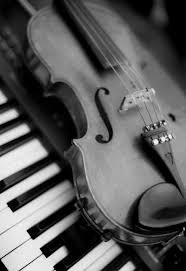
Screeeeeeeech!
There went my bow again—too close to the bridge. "Come on!" I begged out loud. I took a deep breath and tried again.
Screeeeeeeech!
"Aaagh!" I shoved my violin back into the case in frustration and turned to the piano. The piano wasn't hard to find—it was right behind me. In the practice room I had selected, the only space to stand in that wasn't taken up by the baby grand was about the size of a shower. It wasn't optimal conditions for practicing bowing anyway, I told myself. I could work on it more when I got home, where there was more room.
A tuba in the squidgy cubby next to me bellowed "Sorcerer's Apprentice," a jazz group played down the hall and several violins sang hauntingly from somewhere nearby. I sighed as I settled down on the bench, my fingers caressing the cool, familiar black and white keys. Then, I added my own music to the joyous confusion. Bach, Beethoven, Rachmaninoff, Gershwin—even scales! Anything and everything I could think of flowed from my fingers. What a relief! I could make music! Good music—not screeches!
Then, I slowed. I stopped. I sat on the bench quietly. My right hand reached to squeeze my left wrist.
Why me? I thought sadly. Why, when I love the piano so much? This time, it was the left one. Next time, it would probably be the right one. Or both. My dreams of being a piano major teetered again, as they had so many times. Why did my nerves have to keep finding something wrong with my wrists when doctors couldn't?
I sat very still, looking at the blank white keys. I could feel the corners of my eyes prick. I glanced over at my violin, sitting solidly in its second-hand, beat-up brown case. Hateful instrument.
Why on earth am I trying violin? I sighed; I already knew the answer. More than almost anything, I loved making music. If I couldn't make music, it would break my heart. If the time ever came that my wrists stopped my piano altogether . . .
One doctor had told me that stringed instruments were some of the best for wrists. My mom had a leftover violin in a case from a thrift store, and when I came to college she said, "here, this case and everything in it is yours."
That was very generous of her, but now that I had it, I discovered the violin was a monster. It could play things that weren't notes, and it made both my hands do funny things at the same time. I would say trying to play it was like trying to pat my head and rub my stomach simultaneously, except that I could do the latter.
I was not anticipating the recital that my teacher insisted I perform in. I sighed and turned back to the violin. Maybe if I stood sideways, I could bow without hitting the wall . . .
A few days later, I sat in the audience, waiting. Bach, Vivaldi and Gershwin floated past my ears. Yay, I get to play a beginning minuet and "Pop Goes the Weasel," I thought. Then, something dawned on me.
In my piano recitals, the last few years, I've almost always been the last piece on the program. This time I'm not.
The pressure at piano recitals was tremendous—I'd always felt that if I didn't do my best, I wasn't doing credit to all the people who went before me who were expecting me to close the recital with a show-stopping performance.
This time, almost everyone is better than me. If I mess up or not, nobody will really care. Either way, they'll know I'm really bad at violin.
Surprisingly, this humbling realization was liberating.
I can just play! I'm not at the intense stage yet that I am with piano! I don't need to be good immediately, and they'll understand that.
As I played my trick version of "Pop Goes the Weasel," with my arm wound around my head so I was bowing backwards, I squeaked a little. But what with the piano accompaniment (which I composed), maybe nobody noticed. And even if they did, they were too busy appreciating my trick for what it was. They were a kind audience.
I smiled as I took a bow.
Thursday, December 2, 2010
#17 Tree
Me.
Pick me.
Please, pick me.
All around the voices cry.
We hear them, my sister and I.
Me.
This one?
We touch it.
No. Not that one.
We move on. We don't see.
They are disappointed, left behind.
But we don't come back. We don't know.
Me.
We search.
How they bristle.
We shut our ears. Look.
We can't hear them, but we see.
See here. This one. This is the one.
Is it? It is a pancake. But now it says me.
Me.
We hear it.
We see. Yes, we see.
We see that it is a pancake.
Stifled by others, it will unfold.
It does not need to always be a pancake.
It can change in the warmth. We will help it.
Me.
Tree.
Yes, you.
We hear you.
You are an umbrella.
Pick me.
Please, pick me.
All around the voices cry.
We hear them, my sister and I.
Me.
This one?
We touch it.
No. Not that one.
We move on. We don't see.
They are disappointed, left behind.
But we don't come back. We don't know.
Me.
We search.
How they bristle.
We shut our ears. Look.
We can't hear them, but we see.
See here. This one. This is the one.
Is it? It is a pancake. But now it says me.
Me.
We hear it.
We see. Yes, we see.
We see that it is a pancake.
Stifled by others, it will unfold.
It does not need to always be a pancake.
It can change in the warmth. We will help it.
Me.
Tree.
Yes, you.
We hear you.
You are an umbrella.
Wednesday, December 1, 2010
#16 All That Jazz
 Robert Schumann, a famous composer, named the fiery and calm sides of his personality "Florestan" and "Eusebius," respectively. Inspired by him, I've decided to name the bubbly and precautionary sides of my personality after the Latin words for "indulgence" and "conscience." They are "Clementia" and "Conscientia," respectively. Because they generally disagree—sometimes to the point of seeming like two completely different people—I thought they'd make a good practice narrative. If they were to have a conversation, it might go something like this:
Clementia: "You need to hear about my obsession! The world must know, and I'm starting with you!"
Conscientia: "I'd rather not talk about it right now. Let's talk about it later."
Clementia: "No, not later! I'm going to confess right here, right now! Here goes:"
Takes a deep breath.
"I LOVE JAZZ!!! Lovelovelovelovelovelovelovelovelovelovelovelovelove!!!"
Gasps for breath.
Conscientia: "Well, now that that's over with, let's talk. Maybe we can get you over this obsession if we talk it through while it's out in the open."
Clementia: "Okay!"
Conscientia: "All right now, I'm going to ask you some questions, and I want you to just give me honest answers from your heart. Are you ready for the first question?"
Clementia: "Yep!"
Conscientia: "How long have you been obsessed with basketball players?"
Clementia: "Huh?"
Conscientia: "Is it their sweaty bodies and sleek musculature that you view with such complete adoration, or is it the hardcore, neck-in-neck nature of the game?"
Clementia: "—WAIT!!! What are we talking about? I said JAZZ!!!"
Conscientia: "That's what I thought you said."
Clementia: "I meant the MUSIC!!!"
Conscientia: "Oh. I thought you meant the basketball team."
Clementia: "Why on earth would I be thinking about basketball? Life is all about MUSIC!!! Everything is about music! Who cares about basketball, anyway?"
Conscientia: "Shhh! Lots of people love basketball. You don't mind it, yourself."
Clementia: "Maybe, but I LOVEJAZZLOVEMUSICLOVEJAZZMUSICLOVE!!!
As Clementia's eyes cross in rapture, Conscientia throws her hands in the air and gives up.

Clementia: "Oh, Conscientia—you know what else I love to obsession? Chocolatechocolatechocolatechocolatechocolatechocolatechocolate!!!"
Sunday, November 28, 2010
#15 Christus Consolator—A Message of Peace and Hope

Carl Bloch (1834–90) created many beautiful paintings and etchings in his lifetime. One of the most magnificent, in my opinion, is the oil-on-canvas altarpiece from Sofia Albertina Kyrka in Landskrona, Sweden, which Bloch painted in 1884, only six years before his death. It is entitled “Christus Consolator” or “Come Unto Me.” With over 1% of Sweden’s population emigrating annually from Sweden to America during the 1880s, it is likely some of the original congregation who first saw this painting in their church left for America and never saw it again. Now, this painting has come to America, as if following those who came here and left it in years past. My ancestors came from Sweden, so I feel a special connection to this piece of Bloch’s work, as though it followed me from the land of my ancestors to bring me a message of peace and hope.
The message of “Christus Consolator” is well expressed in the Savior’s own words, as quoted by Matthew: “Come unto me, all ye that labour and are heavy laden, and I will give you rest” (Matt. 11: 28–30). The painting shows the blind, lame, captive, beggar, widow, fatherless and others gathering at the feet of the Savior’s towering presence—his size in comparison to the others represents his omnipotence and ability to protect them. His arms are outstretched to the viewer, inviting one and all to come join those at his feet and be protected as they are “under his wings” (Matt. 23: 37).
I thought the presentation of Bloch’s pictures at Brigham Young University’s Museum of Art was very tastefully done. On the wall at the beginning was a quote from Carl Bloch, which said, “God helps me, that is what I think, and then I am calm.” This motto applied not only to Bloch’s personal life, but also to the impression his work and the exhibit left with me. Beautiful, classical music filled the museum instead of the hymns one might expect, reminding visitors that Christ invites those of all denominations to come to him. Many of the altarpieces were framed in a way that suggested the front of a church, letting one get a brief feel for what the picture must have looked like in its original church setting. Overhead lighting made the pictures of Christ sparkle, showing that his light comes from above. The altarpieces had chairs tastefully set in front of them so visitors could sit and contemplate.
I took the opportunity to sit in front of “Christus Consolator” and think for a while. The beautiful message of hope and peace soaked into me as I sat there, and I thought about my own life. I was reminded that I can come to Christ, and he will always be there for me, even in my darkest and most troubled hours. Even when I have no other hope, he will be there for me. “Christus Consolator” was the last piece of the exhibit, and I left with a renewed feeling of peace and hope, and a determination to come to Christ. I know God will help me, so I can be calm. That’s what Bloch’s exhibit did for me.
Subscribe to:
Posts (Atom)