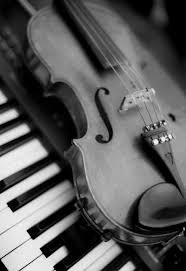
Screeeeeeeech!
There went my bow again—too close to the bridge. "Come on!" I begged out loud. I took a deep breath and tried again.
Screeeeeeeech!
"Aaagh!" I shoved my violin back into the case in frustration and turned to the piano. The piano wasn't hard to find—it was right behind me. In the practice room I had selected, the only space to stand in that wasn't taken up by the baby grand was about the size of a shower. It wasn't optimal conditions for practicing bowing anyway, I told myself. I could work on it more when I got home, where there was more room.
A tuba in the squidgy cubby next to me bellowed "Sorcerer's Apprentice," a jazz group played down the hall and several violins sang hauntingly from somewhere nearby. I sighed as I settled down on the bench, my fingers caressing the cool, familiar black and white keys. Then, I added my own music to the joyous confusion. Bach, Beethoven, Rachmaninoff, Gershwin—even scales! Anything and everything I could think of flowed from my fingers. What a relief! I could make music! Good music—not screeches!
Then, I slowed. I stopped. I sat on the bench quietly. My right hand reached to squeeze my left wrist.
Why me? I thought sadly. Why, when I love the piano so much? This time, it was the left one. Next time, it would probably be the right one. Or both. My dreams of being a piano major teetered again, as they had so many times. Why did my nerves have to keep finding something wrong with my wrists when doctors couldn't?
I sat very still, looking at the blank white keys. I could feel the corners of my eyes prick. I glanced over at my violin, sitting solidly in its second-hand, beat-up brown case. Hateful instrument.
Why on earth am I trying violin? I sighed; I already knew the answer. More than almost anything, I loved making music. If I couldn't make music, it would break my heart. If the time ever came that my wrists stopped my piano altogether . . .
One doctor had told me that stringed instruments were some of the best for wrists. My mom had a leftover violin in a case from a thrift store, and when I came to college she said, "here, this case and everything in it is yours."
That was very generous of her, but now that I had it, I discovered the violin was a monster. It could play things that weren't notes, and it made both my hands do funny things at the same time. I would say trying to play it was like trying to pat my head and rub my stomach simultaneously, except that I could do the latter.
I was not anticipating the recital that my teacher insisted I perform in. I sighed and turned back to the violin. Maybe if I stood sideways, I could bow without hitting the wall . . .
A few days later, I sat in the audience, waiting. Bach, Vivaldi and Gershwin floated past my ears. Yay, I get to play a beginning minuet and "Pop Goes the Weasel," I thought. Then, something dawned on me.
In my piano recitals, the last few years, I've almost always been the last piece on the program. This time I'm not.
The pressure at piano recitals was tremendous—I'd always felt that if I didn't do my best, I wasn't doing credit to all the people who went before me who were expecting me to close the recital with a show-stopping performance.
This time, almost everyone is better than me. If I mess up or not, nobody will really care. Either way, they'll know I'm really bad at violin.
Surprisingly, this humbling realization was liberating.
I can just play! I'm not at the intense stage yet that I am with piano! I don't need to be good immediately, and they'll understand that.
As I played my trick version of "Pop Goes the Weasel," with my arm wound around my head so I was bowing backwards, I squeaked a little. But what with the piano accompaniment (which I composed), maybe nobody noticed. And even if they did, they were too busy appreciating my trick for what it was. They were a kind audience.
I smiled as I took a bow.

No comments:
Post a Comment